How Long Do Ceramic Pans Stay Nonstick? (1-5 Yrs)
Ceramic nonstick pans last 1-2 years with normal use, or 3-5 years with proper care. See what destroys the coating and how to make yours last.

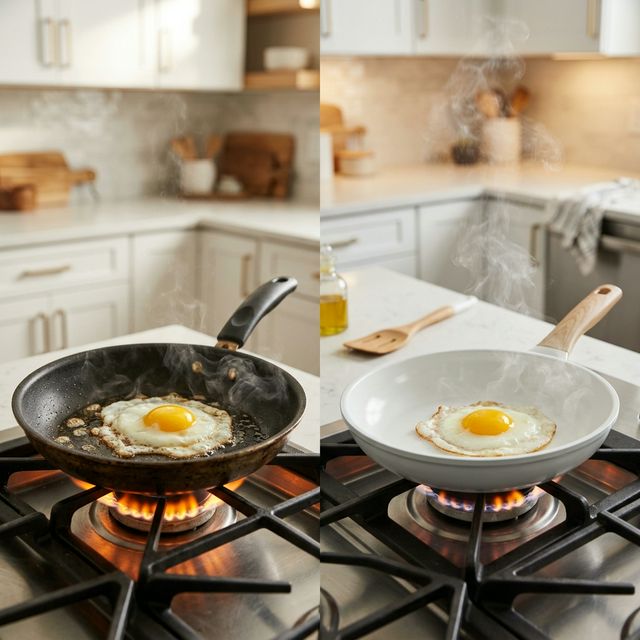
Table of Contents
Affiliate Disclosure: We may earn a commission if you purchase through our links. This doesn't affect our reviews.
Listing check: Amazon titles and photos change. Confirm the steel, length, and model named on this page match the listing before you buy — this is a research note from Nora Whitfield, not a copy of the Amazon product copy.
Affiliate Disclosure: Kitchenware Authority is an Amazon Associate. We earn from qualifying purchases at no extra cost to you. This helps support our independent research and chef-reviewed guides.
You bought a ceramic pan because the eggs slid around like a hockey puck on fresh ice. Six months later, you're scraping scrambled eggs off the surface with a spatula and wondering what went wrong.
You're not alone. The most common complaint about ceramic nonstick cookware isn't safety, price, or weight—it's that the coating doesn't last. And the frustrating part is that most of the damage is preventable.
So how long do ceramic pans actually stay nonstick? The honest answer: 1 to 2 years with typical use, and 3 to 5 years with deliberate care. That gap between "typical" and "deliberate" is where this guide lives. Let's break down exactly what's happening to your coating, what destroys it, and how to squeeze every month of nonstick performance out of your investment.
How Ceramic Nonstick Coating Actually Works
Before you can protect the coating, it helps to understand what it is—and what it isn't.
Ceramic nonstick pans don't have a solid ceramic surface like a clay pot. The "ceramic" label refers to a sol-gel coating, a liquid silicon dioxide (silica) solution that's sprayed onto an aluminum or stainless steel pan body and cured at roughly 800°F during manufacturing.
The result is a thin, glass-like layer—typically 15 to 35 microns thick—that creates a smooth, hydrophobic surface. For reference, a human hair is about 70 microns. So you're working with a coating that's thinner than half a strand of hair.
This is the fundamental tradeoff with ceramic pans. The sol-gel coating is:
- Free of PTFE and PFOA (no risk of toxic fume release at high temps)
- Naturally smooth with excellent initial nonstick release
- Thinner and softer than traditional PTFE coatings
- More vulnerable to mechanical abrasion and thermal degradation
That thinness is why ceramic coatings feel incredible out of the box but degrade faster than PTFE alternatives. If you're weighing the two coating types head-to-head, our nonstick vs. ceramic cookware comparison breaks down the full picture.
Realistic Lifespan Expectations: What the Data Says
Manufacturers love vague language. "Long-lasting nonstick." "Durable ceramic coating." Here's what actually happens in real kitchens:
Months 1–6: Peak Performance
Everything slides. Eggs, pancakes, fish fillets—minimal oil needed. The coating is pristine and the silica surface is fully intact. This is the honeymoon phase.
Months 6–12: Gradual Decline Begins
Micro-abrasions accumulate from utensils, stacking, and cleaning. You might notice eggs need a touch more butter. Food still releases cleanly, but the effortless glide starts requiring a bit of help.
Months 12–18: Noticeable Sticking
Certain foods—cheese, sugary sauces, delicate fish—start sticking in spots. The coating may show visible discoloration (browning or dark spots) from oil polymerization. Seasoning can partially restore performance.
Months 18–24: Functional Decline
The pan still works but is no longer meaningfully "nonstick." You're using as much oil as you would in a stainless steel pan. At this point, most home cooks replace the pan or relegate it to less demanding tasks like reheating.
Months 24–60: Extended Life (With Proper Care)
Cooks who follow every care guideline—low heat, hand wash, silicone utensils, proper storage—can push usable nonstick life well past two years. Three to five years is realistic for premium ceramic pans like the GreenPan Valencia Pro or Caraway lines.
GreenPan Valencia Pro 11-Inch Frypan
The 5 Things That Kill Ceramic Coating Fastest
Understanding these destroyers is more valuable than any care tip. Eliminate even two or three of these habits and you'll double your pan's effective lifespan.
1. High Heat (The #1 Killer)
This is the big one. Ceramic coatings are rated for continuous use at up to 450°F, with most manufacturers recommending you stay at medium or medium-low heat on the stovetop. The sol-gel silica layer begins to break down structurally above 500°F.
The problem? A dry pan on a high gas burner can hit 500°F+ in under 90 seconds. Most home cooks crank the heat because they're used to stainless steel or cast iron, which thrive at higher temperatures.
The fix: Never go above medium heat. Ceramic pans have aluminum cores with excellent heat conductivity—medium on most stoves delivers a surface temperature of 350°F–400°F, which is plenty for searing, sautéing, and frying.
2. Metal Utensils
A stainless steel spatula edge exerts roughly 2,000–4,000 psi of localized pressure on the coating surface. Against a 20-micron sol-gel layer, that's devastating over time.
Every scrape creates micro-scratches invisible to the naked eye but large enough to disrupt the hydrophobic surface. After hundreds of uses, those micro-scratches become macro-sticking.
The fix: Use wood, silicone, or high-temp nylon utensils exclusively. No exceptions.
3. Dishwasher Detergent
Most ceramic pans are labeled "dishwasher safe." Technically true. Practically destructive.
Commercial dishwasher detergents contain alkaline compounds and abrasive microparticles designed to strip baked-on food. They're extremely effective—and they strip the silica coating along with the food residue. The high-pressure water jets and temperatures of 140°F–160°F compound the damage.
The fix: Hand wash with a soft sponge, warm water, and a drop of dish soap. Takes 30 seconds. Adds months to your coating life.
4. Aerosol Cooking Sprays
This one surprises people. Pam, store-brand cooking sprays, and similar aerosol products contain lecithin and propellant additives that build up as a sticky, invisible residue on ceramic surfaces. Over time, this polymerized layer creates the exact sticking problem you bought the pan to avoid.
You'll notice it as a brownish, tacky film that doesn't come off with normal washing. It's not the ceramic coating failing—it's a layer of carbonized spray adhesive sitting on top of the coating.
The fix: Use a small amount of liquid oil—½ to 1 teaspoon of avocado oil, grapeseed oil, or regular olive oil applied with a paper towel. That's all you need.
5. Thermal Shock
Running a 400°F pan under cold tap water creates rapid, uneven contraction in the aluminum core and the ceramic coating. These materials contract at different rates, and the stress can cause micro-cracking and delamination in the sol-gel layer.
The fix: Let the pan cool for 5–10 minutes on a trivet or cool burner before washing. Patience costs nothing and prevents cumulative damage.
Signs Your Ceramic Pan Needs Replacing
Not sure if your pan is past its prime? Look for these indicators:
- Visible scratching or flaking on the cooking surface
- Persistent brown or dark staining that won't wash off (polymerized oil buildup)
- Food sticks even with oil on medium-low heat
- Warped base that wobbles or doesn't sit flat (indicates core damage from thermal shock)
- The "water bead test" fails: Drop a few water droplets on the heated surface—on a healthy ceramic coating, water beads up and dances. On a degraded coating, it spreads flat immediately.
If you're seeing three or more of these signs, it's replacement time. Check our roundup of the best ceramic nonstick pans for current recommendations.
How to Extend Ceramic Nonstick Life to 3–5 Years
Follow these practices consistently and you'll get dramatically more life from your ceramic cookware:
Season Your Ceramic Pan Every 3–4 Months
Yes, ceramic pans benefit from periodic seasoning—just like cast iron, but lighter.
- Wash and dry the pan completely
- Apply ½ teaspoon of grapeseed or avocado oil (high smoke point oils work best)
- Spread it across the entire cooking surface with a paper towel
- Heat on medium-low for 1–2 minutes until the oil just begins to shimmer
- Remove from heat and let cool completely
- Wipe away any excess oil with a clean paper towel
This fills micro-abrasions in the sol-gel coating and restores a thin hydrophobic layer. It's not a permanent fix, but it measurably extends the nonstick window.
Store Pans Properly
Stacking ceramic pans directly on each other grinds the cooking surfaces together every time you pull one out. Use felt pan protectors, dish towels, or cork pads between stacked pans. A $10 set of pan protectors can save you from buying a $60 replacement pan.
Or better yet, hang them. A wall-mounted pot rack eliminates stacking damage entirely.
Match Pan Size to Burner Size
A 10-inch pan on a large burner that heats past the pan's edge creates uneven thermal stress and wastes energy. Conversely, a 12-inch pan on a tiny burner concentrates heat in the center, creating a hotspot. Match your pan diameter to your burner diameter within about an inch.
Pre-Heat the Pan WITH Oil
Don't heat an empty ceramic pan and then add oil. Instead, add your oil to the cold pan and let them heat up together on medium. This ensures even heat distribution and prevents the pan from exceeding safe temperatures before oil is present to moderate the surface temp.
Caraway Nonstick Ceramic Frying Pan
Best Ceramic Pans for Long-Term Nonstick Performance
Not all ceramic coatings are equal. Premium pans use thicker, multi-layer sol-gel applications and harder base metals that hold up significantly longer than budget options.
GreenPan Valencia Pro
GreenPan's Thermolon Minerals Pro coating is one of the thickest ceramic coatings on the market—applied in multiple layers with diamond-infused particles for hardness. The hard-anodized aluminum body provides excellent heat distribution without hotspots. The Valencia Pro line consistently tests well for coating durability past the 24-month mark. Street price for the 11-inch frypan runs $55–$70.
Caraway Ceramic Frying Pan
Caraway uses a proprietary ceramic coating that the company claims is free of over 60 potentially toxic substances. The aluminum core is thick and heavy enough to resist warping. Caraway also includes pan storage accessories with every set purchase, which reduces stacking damage. The individual frypan runs around $95 and comes in multiple colors.
Caraway Nonstick Ceramic Frying Pan
Our Place Always Pan 2.0
The Always Pan 2.0 uses a ceramic coating over an aluminum body with a stainless steel base for induction compatibility. It's a versatile do-everything pan that handles sautéing, steaming, braising, and frying. The coating holds up well with moderate care, and the included beechwood spatula encourages proper utensil habits. Priced at $115–$130, it's an investment piece.
Our Place Always Pan 2.0
Blue Diamond Triple Steel
Blue Diamond's approach layers their diamond-infused ceramic coating over a triple-ply stainless steel body instead of aluminum. This gives you the heat control of stainless steel with the nonstick release of ceramic. The stainless core also eliminates warping concerns entirely. At $40–$50 for the frying pan, it's a strong value pick.
Blue Diamond Triple Steel Ceramic Nonstick Frying Pan
Ceramic vs. PTFE vs. Stainless: Which Lifespan Fits Your Cooking?
Every coating type has a lifespan tradeoff:
| Cookware Type | Nonstick Lifespan | Best For |
|---|---|---|
| Ceramic nonstick | 1–5 years (care dependent) | Health-conscious cooks, egg/fish cooking |
| PTFE nonstick | 3–5 years | Everyday convenience, low-fat cooking |
| Stainless steel | 15–20+ years | Searing, deglazing, durability |
If you want a pan that never loses its nonstick coating, you may want something without a coating altogether. Our stainless steel cookware guide covers the learning curve and technique.
And if the PTFE vs. ceramic safety question is on your mind, we've done a deep dive on whether ceramic pans are actually safer than their traditional nonstick counterparts.
For cooks who want nonstick without PTFE specifically, our list of the best nonstick pans without Teflon covers the full range of alternatives, including ceramic, carbon steel, and seasoned cast iron.
The Bottom Line
Ceramic nonstick pans are not lifetime cookware. They were never designed to be. The sol-gel coating is a consumable surface—think of it like brake pads on a car. They wear out with use, and the speed of that wear depends almost entirely on how you drive.
The realistic range is 1 to 5 years of meaningful nonstick performance. Most people land at 12–18 months because they use high heat, toss them in the dishwasher, and grab whatever spatula is closest. Cooks who treat the coating with intention—medium heat, hand washing, silicone utensils, periodic seasoning—routinely get 3+ years from premium pans.
The math works out either way. A $60 ceramic pan that lasts 3 years costs $20 per year. A $30 budget pan that lasts 8 months costs $45 per year. Buy quality, treat it right, and ceramic nonstick remains one of the best PTFE-free options on the market.
Now go season your pan.
Nora Whitfield
Writer, Kitchenware Authority
Nora Whitfield writes Kitchenware Authority's reviews and buying guides. Every knife, pan, and appliance is vetted against maker specifications, materials and safety documentation, and the long-run experience verified home cooks report — not first-hand lab tests.
Upgrade Your Kitchen Skills
Get research-based gear reviews, maintenance tips, and buying guides from the Kitchenware Authority desk.
No spam. Research notes from Nora Whitfield, not invented reader counts.