Best Ceramic Nonstick Pans: Safe PFAS-Free Picks
Best ceramic nonstick pans, with PFAS-free picks from GreenPan, Caraway, Our Place, T-fal, and Blue Diamond.

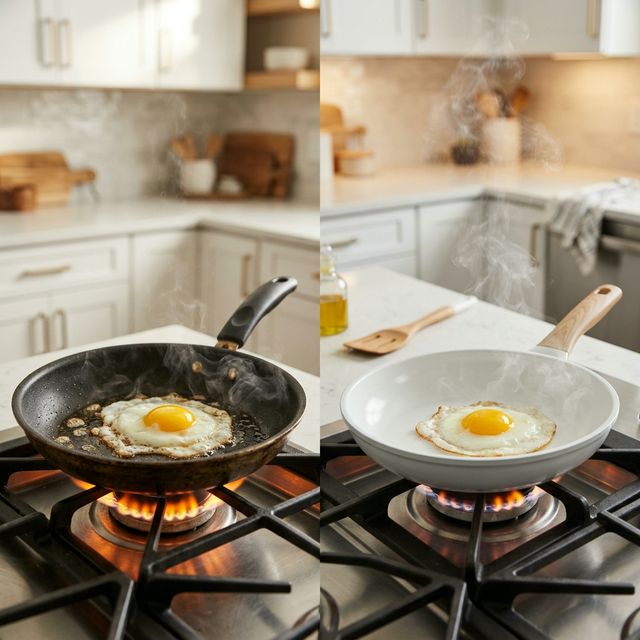
Table of Contents
Affiliate Disclosure: We may earn a commission if you purchase through our links. This doesn't affect our reviews.
Listing check: Amazon titles and photos change. Confirm the steel, length, and model named on this page match the listing before you buy — this is a research note from Nora Whitfield, not a copy of the Amazon product copy.
Ceramic nonstick is the PFAS-free pitch: a silica-based coating, no PTFE fumes if you overheat the pan, and easy eggs for a while. The catch is already on the care card. Sol-gel ceramic is a thin glass-like film, not a solid ceramic pot, and it wears. This page is the single-pan shortlist — which fry-pan SKU to open, and what to read on the listing so you do not buy a different coating under the same brand name.
This is a research-based guide, not a hands-on test. Nora Whitfield's desk compared manufacturer specification sheets, care booklets, and the complaints that repeat in verified owner reviews. We did not run a six-month egg diary or score coatings in a lab. Where a number is a maker rating, it is labeled as such. For how long that slickness usually lasts, use how long ceramic pans stay nonstick. For the chemistry question, use ceramic vs Teflon safety.
Bottom line: Buy the GreenPan Valencia Pro 12-inch if you want one ceramic fry pan with a documented hard-anodized body and an induction disk. Buy Caraway if the pan is furniture. Buy T-fal Initiatives Ceramic only if you treat the pan as a consumable and you have confirmed the word ceramic on the actual SKU.
Best Ceramic Nonstick Pans: Quick Picks
| Need | Best ceramic nonstick pan | Why it fits |
|---|---|---|
| Best overall | GreenPan Valencia Pro 12-Inch | Hard-anodized body, Thermolon Infinity, Magneto base — confirm Pro, not Rio or Level |
| Best premium pan | Caraway Fry Pan | Open-stock 10.5-inch ceramic; the magnetic rack is usually a set extra |
| Best versatile pan | Our Place Always Pan 2.0 | Deeper walls and a steamer basket; 450°F oven limit is the trade |
| Best budget pan | T-fal Initiatives Ceramic 12-Inch | Low price if the title actually says Ceramic, not PTFE Initiatives |
| Best budget durability claim | Blue Diamond 12-Inch Fry Pan | Confirm ceramic, not Blue Diamond's PTFE line, before you click |
If you need a full set instead of one skillet, use the ceramic cookware sets guide. If the stove is open flame, use ceramic cookware for gas stoves and the how-to on using ceramic on gas. If you would rather leave ceramic behind, the nonstick pans without Teflon roundup and the stainless steel cookware guide are the other doors.
How this desk chose
We ranked published construction, not a kitchen trial:
- Coating name on the spec sheet. Thermolon Infinity, a named Caraway ceramic, or a generic "ceramic nonstick" line — the name is what you match on Amazon.
- Body and base. Hard-anodized thickness and an induction disk (GreenPan Magneto) versus thin aluminum that only works on gas and electric.
- Oven number that applies to the handle and lid, not just the pan body. Listings often quote the higher number.
- Owner-pattern failures. Sticking after high heat, spray buildup, dishwasher dulling, and edge wear on tall sidewalls.
We did not invent month-by-month release scores. Those numbers cannot be honest without a test we did not run.
Before you click: listing checks Amazon blurbs skip
Amazon titles in this category mash together ceramic, "diamond," and PTFE. Read the bullet list, not the badge.
- The coating family. If the detail section mentions PTFE, PFOA-free Teflon, or "reinforced nonstick" without silica/sol-gel/ceramic, it is not this guide's product. Blue Diamond and T-fal both sell ceramic and fluoropolymer pans under similar names.
- The exact line. Valencia Pro is not Valencia, Rio, or Level. Always Pan 2.0 is not the original Always Pan. Initiatives Ceramic is not Initiatives with Thermo-Spot PTFE.
- Fry pan versus set bundle. Caraway and GreenPan search results mix open-stock skillets with 10- and 11-piece sets. Price and included lids change.
- Induction. A magnetic stainless disk or Magneto base is a yes. Bare aluminum is a no. "Works on all cooktops" is not enough if your range is induction.
- Oven-safe fine print. Body ratings of 550–600°F often sit next to lid knobs or helper handles rated lower. If you finish under a broiler, read both numbers.
- Utensil and dishwasher language. "Metal-utensil safe" on a ceramic listing is a warranty posture, not a longevity plan. Hand wash anyway.
For PFAS wording on a specific brand claim, CeraLAST and PFAS shows how to verify the label yourself. For the broader "are ceramic pans toxic" question, see ceramic pan safety.
The 5 Best Ceramic Nonstick Pans
1. GreenPan Valencia Pro 12-Inch — Best Overall
Coating: Thermolon Infinity | Body: Hard-anodized aluminum | Oven-safe body: 600°F (confirm lid/handle on the SKU)
Valencia Pro is the ceramic fry pan this desk sends people to first because the published build is thicker than GreenPan's entry lines and the Magneto base is an actual induction disk, not a marketing synonym for "flat bottom." Owner reviews that last past the honeymoon month tend to mention even heat and a stay-cool handle — and they also mention that the bronze interior makes fond harder to see than a light-colored ceramic.
Listing check: The Amazon title must say Valencia Pro. Rio and Level use different Thermolon generations and lighter bodies. A 12-inch open-stock pan is not the 11-piece set. If you cook on induction, look for Magneto or "induction" in the spec table, not only in a lifestyle photo.
GreenPan Valencia Pro 12-Inch Ceramic Nonstick Pan
2. Caraway Fry Pan 10.5-Inch — Best Premium Experience
Coating: Caraway ceramic (sol-gel) | Body: Aluminum | Oven-safe body: 550°F
Caraway sells the unboxing: color, magnetic organizer, canvas lid holder. The fry pan itself is a competent ceramic aluminum skillet. It is not the heaviest body in this list, which is why owner threads talk about faster heat-up and less forgiveness if you jump to a tall flame. Colors share the coating; you are paying for the finish and the storage kit, not a different nonstick chemistry.
Listing check: Open-stock Caraway fry pans are typically 10.5 inches, not 12. The magnetic rack and lid holder are set accessories — do not assume they ship with a single pan. Confirm ceramic cookware, not their bakeware or food-storage add-ons, in the same colorway.
Caraway Nonstick Ceramic Frying Pan
3. Our Place Always Pan 2.0 — Most Versatile
Coating: Our Place ceramic | Body: Aluminum | Oven-safe: 450°F
The Always Pan is a deeper saute-style shape with pour spouts and, on current 2.0 listings, a steamer basket. That geometry is the reason to buy it: one vessel for a small kitchen. It is also why edge-flame wear shows up in gas-stove owner comments — taller walls catch more side heat. The 450°F oven rating is the lowest on this page; it is the wrong pan if you regularly finish under a broiler.
Listing check: The title must say Always Pan 2.0. Confirm the steamer and spatula are in the "what's in the box" list for that ASIN. Induction is a no on the standard aluminum 2.0 unless the listing adds a magnetic base — most do not.
Our Place Always Pan 2.0
4. T-fal Initiatives Ceramic 12-Inch — Best Budget
Coating: Ceramic | Body: Aluminum | Oven-safe: 350°F
This is the consumable ceramic pan. The price only makes sense if you expect to replace it, which is how a lot of households already treat nonstick. Owner patterns for thin ceramic on a budget line are consistent: strong release when new, faster fade if you use high heat or the dishwasher, and a plastic handle that keeps the oven number low.
Listing check: T-fal Initiatives is a family. Many hits are PTFE with a Thermo-Spot. The title and spec table must say ceramic. 350°F oven-safe means this pan does not go under a broiler. If the photo shows a red heat-indicator spot, you are probably on the fluoropolymer SKU.
T-fal Initiatives Ceramic 12-Inch Fry Pan
5. Blue Diamond 12-Inch Fry Pan — Best Durability Promise
Coating: Diamond-infused ceramic (confirm) | Body: Aluminum | Oven-safe body: 600°F on the ceramic fry-pan SKUs
Blue Diamond's catalog is the easiest place to buy the wrong chemistry. The brand sells diamond-reinforced PTFE and diamond-infused ceramic. The ceramic SKU is the one that belongs here. Maker copy claims a harder film; owner reviews more often say "needed a bit more oil from day one" and "held up better than the cheapest ceramic," not "forever nonstick."
Listing check: Open the description and search for ceramic or sol-gel. If you only see PTFE or "PFOA-free nonstick," stop. The 12-inch fry pan is not the Triple Steel stainless-body line — that heavier construction is covered in the gas-stove set guide.
Blue Diamond 12-Inch Ceramic Fry Pan
How to make ceramic pans last
These rules are the ones maker booklets and long-running owner threads agree on. They are not a wear-test protocol.
- Medium heat is the ceiling. High heat is the fastest way to dull sol-gel. Eggs, pancakes, and most saute work do not need a ripping flame.
- Oil or butter, not cooking spray. Aerosol lecithin builds a gummy film that feels like a dead coating.
- Silicone or wood only. Metal leaves scratches that become sticky tracks.
- Hand wash, soft sponge. Dishwasher heat plus detergent is a common owner complaint.
- Cool before water. Thermal shock is in the care PDFs for a reason.
- Protect the face if you stack. A felt or silicone separator is cheaper than a new pan.
Daily care detail lives in the ceramic pan care guide. If the coating is already gone, replacement timing is in how long ceramic pans stay nonstick.
The safety case, without the brochure
Ceramic sol-gel is silica-based. It is not PTFE, PFOA, or GenX. That is the honest advantage for households that want to stay off fluoropolymers — including kitchens with pet birds, which are famously sensitive to PTFE fumes. It is not a promise that the pan is immortal, or that a no-name "ceramic" listing is the same chemistry as GreenPan or Caraway. Verify the coating. Then cook like the booklet says.
If you want stainless for searing and sauces instead, the All-Clad D3 12-inch skillet review is the single-pan contrast on this site.
Frequently Asked Questions
What is the best ceramic nonstick pan overall?
The GreenPan Valencia Pro 12-inch is the default pick on published build: hard-anodized body, named Thermolon Infinity coating, Magneto induction base. Confirm the Pro SKU on the listing.
Are ceramic pans really PFAS-free?
Named lines from GreenPan, Caraway, and Our Place describe PFAS-free sol-gel coatings. Generic ceramic titles can hide hybrid or PTFE formulas. Read the spec sheet.
Why do ceramic pans lose their coating?
Heat, metal tools, dishwashers, and cooking spray. Medium heat and hand washing are the two habits that show up most often when owners say a pan lasted.
Is GreenPan better than Caraway?
GreenPan Valencia Pro for documented body and induction. Caraway for color and the storage ecosystem. Different jobs.
How do you make ceramic pans last longer?
Medium heat, real oil, silicone or wood, hand wash, cool before rinse, protect stacked faces. Details are in the ceramic care guide.
Nora Whitfield
Writer, Kitchenware Authority
Nora Whitfield writes Kitchenware Authority's reviews and buying guides. Every knife, pan, and appliance is vetted against maker specifications, materials and safety documentation, and the long-run experience verified home cooks report — not first-hand lab tests.
Upgrade Your Kitchen Skills
Get research-based gear reviews, maintenance tips, and buying guides from the Kitchenware Authority desk.
No spam. Research notes from Nora Whitfield, not invented reader counts.