Best Sous Vide Machines for Home Cooks
A research-based comparison of the best sous vide precision cookers. Discover how Anova, Breville Joule, and others rank for temp accuracy.

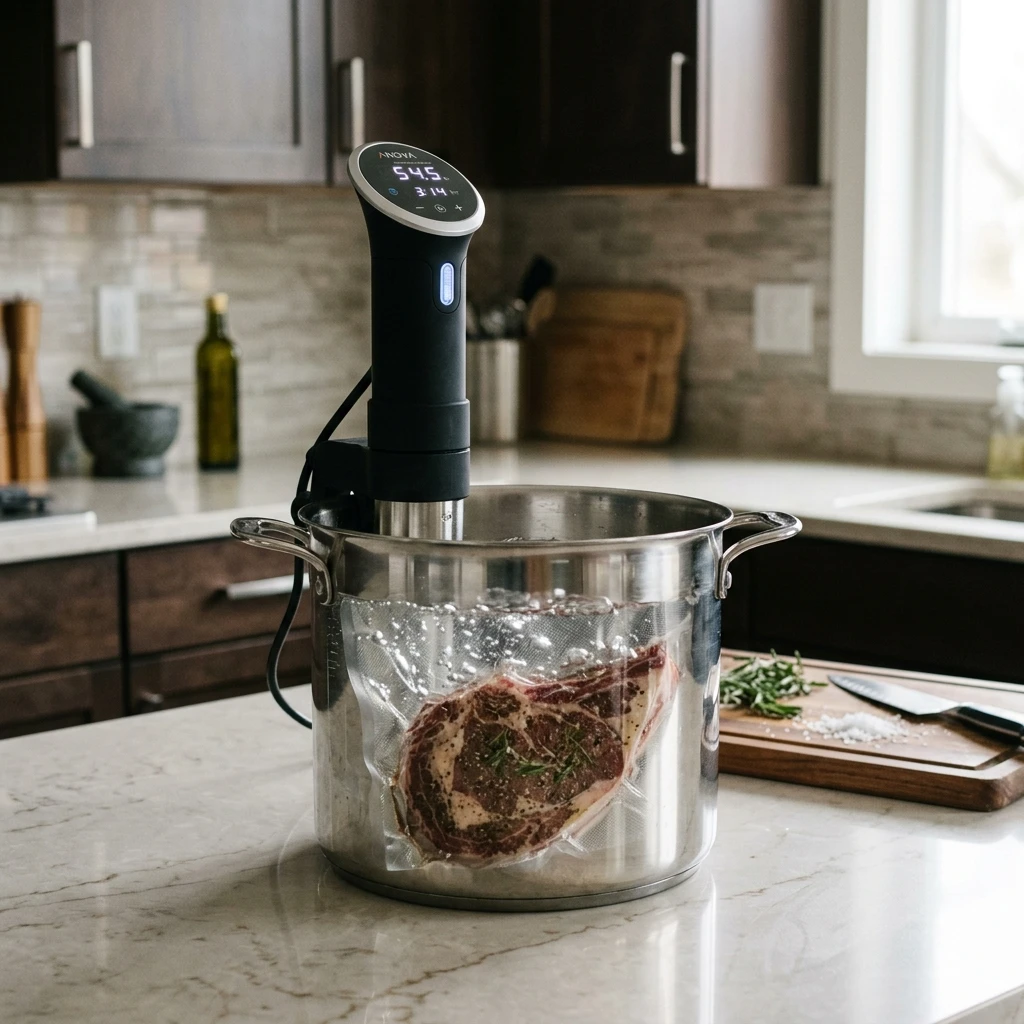
Table of Contents
Affiliate Disclosure: We may earn a commission if you purchase through our links. This doesn't affect our reviews.
Listing check: Amazon titles and photos change. Confirm the steel, length, and model named on this page match the listing before you buy — this is a research note from Nora Whitfield, not a copy of the Amazon product copy.
A sous vide machine for a home cook is a clamp-on or magnetic immersion circulator. It heats a pot of water and keeps that water moving so a sealed bag of food sits at one temperature. Restaurant menus treat that as a secret. At home it is a thermostat and a pump.
This is a research-based guide, not a hands-on test. Nora Whitfield's desk compared current Anova and Breville maker pages, listed wattage and control layouts, and the owner complaints that repeat: cracked plastic clamps, app subscriptions, and listings that mix the original Joule with Joule Turbo. We did not run a water-bath lab or score steaks. And the finish still belongs to a good instant-read or leave-in meat thermometer, not a circulator brochure.
Disclosure: this site earns from qualifying purchases made through the Amazon links on this page. The order below follows published specs and recurring owner feedback, never the link.
Desk take: Buy the Anova Precision Cooker 3.0 if you want time and temperature on the stick itself. Buy Breville Joule Turbo only if you are fine controlling the cook from a phone. If you mainly want weeknight stew speed, read Instant Pot vs slow cooker first — a circulator is a different job.
What a listing will not tell you
Amazon tiles for "sous vide machine" mix circulators, vacuum sealers, water ovens, and multi-cookers with a sous vide button. Half the shopping job is telling those categories apart — the same junk-drawer problem that sells people kitchen gadgets they never use.
- On-device controls versus app-only. Anova 3.0 publishes a two-line touch screen so you can set time and temperature without unlocking a phone. Joule Turbo has no physical screen. If the cook starts when your hands are wet, that difference matters more than wattage.
- 3.0 is not Nano, not Pro, not 2.0. Anova still sells smaller and older sticks. The current flagship copy says 1100 watts, dual-band Wi-Fi, an adjustable detachable clamp, and a removable skirt. A 750–800W Nano listing is a different machine.
- Joule versus Joule Turbo versus Joule Oven. The original ChefSteps Joule (often CS10001 on older tiles) is compact and app-only. Joule Turbo keeps the magnetic foot and adds Turbo-mode software. A Joule oven is a countertop oven, not a stick. Search titles that say only "Joule" are a junk drawer.
- Clamp versus magnet. Anova's clamp is meant for pot rims. Joule's magnet stands in steel or induction-ready cookware and ships a narrow clip for plastic tubs. A thin enamel pot may not hold a magnet. Owner photos of a leaning stick are usually the wrong vessel, not a broken heater.
- Minimum water line. Every circulator has a min/max window printed on the skirt. A wide stockpot that looks "big enough" can sit below the intake. A Cambro-style rectangle is easier to read than a flared Dutch oven.
- Subscription copy. Anova's app still splits free device control from a paid recipe layer. You can run the 3.0 from the stick. Do not treat a recipe paywall as a hardware defect.
- Wattage is heating speed, not cooking quality. A bigger element brings a cold bath to target faster and recovers faster when you drop in a cold roast. Once the bath is at temperature, both flagship sticks throttle back and hold. Paying for watts you will not use is the most common overspend in this category.
How a circulator actually cooks
Two ideas do all the work, and neither requires expensive hardware.
Water cannot overshoot its setting. A bagged steak in a 130°F bath drifts up toward 130°F and stops. The interior cannot blow past the bath temperature no matter how long it sits, which is why the technique forgives distraction in a way a hot pan or an oven does not. The trade you accept is texture: hold too long and soft proteins keep softening.
The pump removes cold spots. Still water stratifies — hot at the top, cool at the bottom, cold against a chilled bag. The circulator's impeller keeps the whole bath at one reading, which is the actual difference between a circulator and a multi-cooker that merely heats water.
Browning is a separate step. Maillard browning needs surface temperatures far above what any water bath can reach, because water cannot exceed its boiling point. That is why every sous vide recipe worth reading ends with a hard sear in a cast iron or stainless pan, under a broiler, or on a grill — the bath cooks, the pan colors.
Best overall: Anova Precision Cooker 3.0
Anova's current Precision Cooker 3 page lists 1100 watts, dual-band Wi-Fi, a two-line display, an adjustable detachable clamp, a removable skirt, and IPX7 water resistance on the stick. US listings often show model family AN525. That is the home-cook default because you can start a bath from the device.
Listing check: Title should say Precision Cooker 3.0 or Precision Cooker 3, 1100W, and Wi-Fi. Skip Nano, Precision Cooker 2.0, and "Precision Oven" hits. Confirm the clamp is in the box — Anova sells the clamp assembly as a spare because the plastic screw is a known wear part. Do not overtighten it.
Owner patterns that repeat: the 3.0 is louder than some 2.0 units; Wi-Fi setup is the usual first-week complaint; the skirt twists off for cleaning. None of that is a secret steak lab. It is what the listing and the long-term threads already agree on.
Why it wins the default pick: buttons on the stick mean the cook survives a dead phone, a deleted app, or a recipe-paywall decision you disagree with. The removable skirt makes the one real cleaning chore (scale buildup in hard-water areas) a five-minute job instead of a soak-the-whole-stick evening.
Check current Anova Precision Cooker 3.0 price
Premium compact: Breville Joule Turbo
Breville's Joule Turbo materials list 1100 watts, a magnetic stainless foot, a universal clip, Bluetooth plus Wi-Fi, and a short cylinder (about 12.2 inches). There is no onboard screen. Turbo mode is a software path that shortens some published cooks; it is not a second heating element.
Listing check: Look for Joule Turbo, not the older white-and-steel original Joule and not a Joule Oven. If the photo shows a small LED window on the stick, you are looking at a different brand. Confirm 120V if you are in North America — Breville's older Joule copy warned that transformers void the warranty.
Buy this if drawer space and a magnetic Dutch oven matter more than tactile buttons. Skip it if you do not want a phone in the cook.
Why people keep it anyway: the short cylinder fits a drawer and a stockpot alike, the magnetic foot plants the stick firmly in steel vessels, and the app's visual doneness guides are the friendliest in the category for a first-timer. The cost of admission is accepting that the app is the only interface.
Check current Breville Joule Turbo price
Anova 3.0 vs Joule Turbo at a glance
Both sticks publish the same heater rating, so the real fork is the interface and the mount — not raw power.
| Anova Precision Cooker 3.0 | Breville Joule Turbo | |
|---|---|---|
| Heater | 1100 watts | 1100 watts |
| On-stick controls | Two-line touch screen | None — app required |
| Wireless | Dual-band Wi-Fi | Wi-Fi plus Bluetooth |
| Mount | Adjustable detachable clamp | Magnetic foot plus universal clip |
| Body | Removable skirt, IPX7-rated stick | Sealed short cylinder, about 12.2 inches |
| Extra software | Free device control, paid recipe layer | App-guided cooks, Turbo mode |
Read the table as a workflow choice. If you cook from a paper note or your memory, the left column wins. If your phone is already open on the counter, the right column stops mattering.
When a multi-cooker is enough
Instant Pot Duo Plus and some later Instant models list sous vide as one of several modes. That function holds water in the inner pot. It does not replace a circulator's pump. Bags can sit against a hot bottom. If you already own the multi-cooker and want to try one pork chop, use that mode and a thermometer — and our beginner Instant Pot recipes are a better first week than a water bath. If you want a weekly bath, buy the Anova.
The buying fork is the same one in Instant Pot vs slow cooker and its cousin, the difference between an Instant Pot and a slow cooker: pressure and all-day braise are different tools from a circulator. A sous-vide slow cooker listing is another Amazon mashup — see adjustable slow cookers if the real job is a ceramic crock with a probe.
Containers, clamps, and counter space
The circulator is half the purchase; the vessel is the other half, and it is where most first-week frustration lives.
- Any tall pot works if the water covers the min line. The min/max window is printed on the skirt. Measure your usual pot's water height before blaming the heater for a slow cook or an error code.
- Rectangular food-safe containers earn their keep. A Cambro-style rectangle makes the water line easy to read, gives the clamp or clip a square rim to bite, and lets bags sit apart instead of tangling. Round stockpots work; rectangles are simply easier to live with.
- Cover the bath on long cooks. A lid or a cut sheet of foil cuts evaporation dramatically on overnight and 24-hour-plus cooks, and evaporation is what drops a bath below the minimum line mid-cook.
- Match the mount to the vessel. The Joule magnet wants steel or induction-ready bases; a thin enamel pot may refuse it. The Anova clamp wants a rim it can grip — check that a silicone-edged lid still closes over the stick.
- Budget for displacement. A family-size batch pushes water up fast. Fill low, add the food, then top up to the max line rather than the reverse.
Bags, finish, and safety notes this desk will actually stand behind
- Use freezer-grade zip bags or rated vacuum pouches. Keep the seal above the water.
- USDA published safe minimum internal temperatures still apply — poultry needs 165°F no matter how long it swam. A 130°F bath is a steak preference, not a poultry finish.
- Sear in a dry, hot pan or on a grill after the bath. The circulator does not brown.
- Confirm the finish with a leave-in or instant-read thermometer. Time-at-temperature tables for pasteurization come from food-safety research, not from the stick's display.
- Chill or ice baths for make-ahead cooks: food that will be refrigerated and reheated should go straight from the bath into an ice bath per the recipe's guidance, not sit warm on the counter.
Sous vide FAQ
What is sous vide cooking?
Sous vide (French for "under vacuum") cooks food in a sealed bag in a water bath held at a set temperature by an immersion circulator. The circulator heats and moves the water so the bath stays even.
Is plastic safe to cook sous vide?
Use bags sold as food-safe for cooking, not thin sandwich bags. Maker pages for vacuum pouches and silicone bags list a temperature rating. Stay inside that rating. Typical steak and chicken cooks sit well under 185°F.
Do you need a vacuum sealer for sous vide?
Not for most home cooks. A sturdy zip-top freezer bag plus the water-displacement method — lower the bag slowly so water pushes the air out, then seal — is the usual weeknight setup. A sealer helps with long cooks and freezer batches.
Why cook steak sous vide?
The bath can sit at the target doneness temperature, so the interior can finish edge to edge before a short, hot sear. That is a geometry and heat-control argument, not a promise that every steak will taste the same.
Can an Instant Pot replace a sous vide circulator?
Some Instant Pot Duo Plus and later multi-cookers list a sous vide mode. That mode holds a pot of water; it does not circulate like a clamp-on circulator. Use it for occasional bags. Buy a dedicated circulator if water-bath cooking is a weekly habit.
Verdict
Anova Precision Cooker 3.0 is the home-cook circulator to buy when you want wattage, a clamp, and buttons on the stick. Joule Turbo is the compact, app-first alternative for cooks whose phone already runs the kitchen. Do not let a multi-cooker tile sell itself as the same machine, and do not pay for a circulator before you know whether your pot, your counter, and your patience actually want one.
Sources checked
Nora Whitfield
Writer, Kitchenware Authority
Nora Whitfield writes Kitchenware Authority's reviews and buying guides. Every knife, pan, and appliance is vetted against maker specifications, materials and safety documentation, and the long-run experience verified home cooks report — not first-hand lab tests.
Upgrade Your Kitchen Skills
Get research-based gear reviews, maintenance tips, and buying guides from the Kitchenware Authority desk.
No spam. Research notes from Nora Whitfield, not invented reader counts.