Best Rice Cookers 2026: Analog, Fuzzy Logic, and Induction
The best rice cookers for 2026, compared: from basic on/off models to fuzzy logic and induction, find the right one for your kitchen.

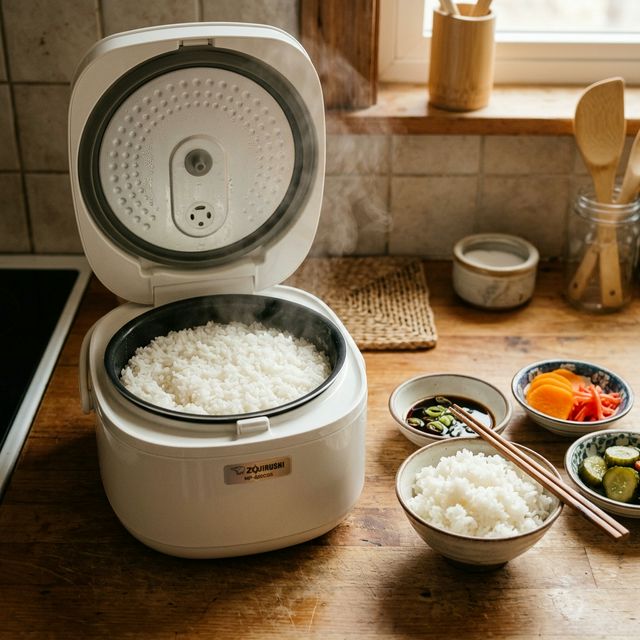
Table of Contents
Affiliate Disclosure: We may earn a commission if you purchase through our links. This doesn't affect our reviews.
Listing check: Amazon titles and photos change. Confirm the steel, length, and model named on this page match the listing before you buy — this is a research note from Nora Whitfield, not a copy of the Amazon product copy.
A rice cooker is a dedicated pot with a heater, a thermal sensor, and — on mid and high machines — a microcomputer that stages soak, boil, steam, and rest. It is not a multi-cooker with a Rice button, and it is not a pot on a glass-top burner.
This is a research-based guide, not a hands-on test. Nora Whitfield's desk compared current Zojirushi and Hamilton Beach maker pages, cup-capacity footnotes, heating-system labels, and the listing mix-ups that waste a click: NS-TSC10 versus NS-TSC18, NP-HCC versus NP-NWC, and digital Hamilton Beach tiles that hide the model number. We did not run a rice lab or score sweetness. Prices and bundles move, so this page stays on identity you can verify before you order.
Desk take: Buy the Zojirushi NS-TSC10 if rice is weekly and you want Micom menus without induction. Buy a digital Hamilton Beach only for basic white rice on a budget. Step up to NP-HCC10 only if you specifically want induction heating. If you want one-switch analog, use the analog rice cooker guide first.
If the real job is chopping, shredding, or dough, a rice cooker will not do it. Use the food processor guide. If the real job is pressure plus slow cook, use Instant Pot vs slow cooker.
What a listing will not tell you
Amazon tiles for "best rice cooker" mix analog levers, cheap digital pots, Micom Zojirushi units, induction pots, and Instant Pot clones.
- Japanese cups are not U.S. cups. Zojirushi measures capacity in the 180 ml / 6.1 fl oz rice cup, using raw short-grain white rice. A 5.5-cup NS-TSC10 is not 5.5 American cups of uncooked rice. Listings that omit that footnote are incomplete.
- NS-TSC10 is not NS-TSC18. Same Micom family, different size. Zojirushi lists NS-TSC10 at up to 5.5 cups / 1.0 liter and 610 watts; NS-TSC18 at up to 10 cups / 1.8 liters and 820 watts. A 10-cup pot making two cups of rice is the wrong tool.
- NP-HCC is not NP-NWC. NP-HCC is induction heating with a triple heater and menus that include GABA brown and jasmine. It is not a pressure cooker. NP-NWC is the pressure-induction line with AI and a different pan. Titles that say "Zojirushi induction" without the model prefix are a junk drawer.
- Hamilton Beach 37548 is not 37518. Digital programmable tiles mix the larger 37548 (Hamilton Beach publishes 2–14 cups cooked / 7 uncooked) with the smaller 37518. Confirm the model number and cooked-cup range. Neither is Micom, and neither is a one-lever analog cooker.
- All-Clad is a different fork. If you want a stainless body and simpler controls, read the All-Clad rice cooker review and the All-Clad vs Zojirushi comparison before you treat every stainless cooker as a Zojirushi.
Types of rice cookers
Basic on/off (analog)
A thermal sensor trips when the water is absorbed and the pot temperature rises past boiling. That is the whole mechanism. It is enough for everyday white rice. It is weaker on brown rice, sushi rice, and long keep-warm.
Skip this type if: you want brown-rice or sushi menus, or you leave rice on warm all day. Start with the best analog rice cooker guide if a one-switch pot is the actual job.
Fuzzy logic / Micom
A microcomputer stages soaking, heat-up, boil, steam, and rest, and it can compensate for water temperature and load. Zojirushi's NS-TSC page lists white/sushi, mixed, porridge, sweet, brown, cake, steam, and quick cooking, plus automatic keep warm, extended keep warm, and a reheat cycle.
This is the usual home-cook default. For brand-by-brand Micom notes, use the fuzzy logic rice cooker guide.
Skip this type if: you only make white rice a few times a month and will not use the extra menus.
Induction heating (and pressure induction)
Induction heats the inner pot electromagnetically instead of a bottom plate alone. Zojirushi's NP-HCC page lists a triple heater (bottom, side, and lid), GABA brown, jasmine, and white rice that can be set regular, softer, or harder. That is still not pressure.
Pressure induction is a separate purchase. Do not pay IH-and-pressure money for an NP-HCC listing, and do not assume an NP-NWC listing is the same cooker with a different color.
Skip induction if: rice is not a daily staple. Micom already covers most home menus.
What to look for
Capacity
Match the cooker to how much uncooked rice you actually make, in the maker's 180 ml cups.
- 3-cup class: one or two people.
- 5.5-cup class: the common family size, including NS-TSC10 and NP-HCC10.
- 10-cup class: NS-TSC18 / NP-HCC18 / NP-NWC18, for large batches.
Bigger is not automatically better. A half-empty 10-cup cooker is the usual owner complaint after someone bought "the large one" from a photo.
Inner pot
Nonstick aluminum is common and easy to wash; the coating wears and replacement pans are sold as parts. Stainless pots last longer and stick more. Ceramic-coated pots sit in the middle. Confirm the replacement-pan SKU on the maker parts page if you expect daily use for a decade.
Keep warm
Every cooker above a bare analog switch has a warm mode. The useful question is whether the maker lists extended keep warm and reheat, as Zojirushi does on NS-TSC, or only a generic warm light. Cheap digital pots often dry rice out sooner; that is a keep-warm design limit, not a secret rice recipe.
Our top picks
Best overall: Zojirushi NS-TSC10 5.5-cup Micom
Zojirushi's current NS-TSC page is a Micom cooker with a stainless-brown exterior, a detachable inner lid, a steaming basket, cake and steam menus, two delay timers, and 610 watts on the 5.5-cup body. It is made in a Zojirushi factory in China. It is the default because the menus and keep-warm options are published, and because 5.5 cups matches most households better than the 10-cup sibling.
Listing check: Title should say NS-TSC10 or Micom Rice Cooker & Warmer NS-TSC, 5.5 cup. Skip NS-TSC18 unless you need 10 cups. Skip Neuro Fuzzy NS-ZCC, IH NP-HCC, and pressure NP-NWC tiles that reuse a stainless-brown photo. Confirm the steaming basket is in the box — Zojirushi lists it as an accessory for this family.
Skip this cooker if: you want induction, you need a 10-cup pot, or you only want a one-switch analog cooker.
Check current Zojirushi NS-TSC10 5.5-cup price
Best budget digital: Hamilton Beach programmable
Hamilton Beach's digital programmable cookers use preset buttons (white rice, whole grain, steam, keep warm) and a nonstick pot. They are not Micom and they are not induction. For cooks who mainly want white rice and a steam basket without a Zojirushi bill, that is enough.
Listing check: Confirm 37548 versus 37518. The 37548 is the larger digital simplicity cooker Hamilton Beach describes as 2–14 cups cooked. The 37518 is the smaller sibling. A title that says only "8-cup" or only "digital programmable" is incomplete. This is also not the analog one-switch Hamilton Beach pot.
Skip this cooker if: brown rice, sushi rice, or all-day keep-warm is the job. Those menus are why people step up to NS-TSC.
Check current Hamilton Beach digital rice cooker price
Best induction step-up: Zojirushi NP-HCC10
The NP-HCC10 is Zojirushi's 5.5-cup induction cooker, listed at 1,230 watts, made in Japan, with a triple heater and menus that include GABA brown and jasmine. The maker page does not list pressure settings. The Umami / pressure story belongs to NP-NWC, not this pot.
Listing check: Look for NP-HCC10 or Induction Heating System Rice Cooker NP-HCC. Skip NP-HCC18 unless you need 10 cups. Skip NP-NWC10/18 pressure-induction tiles, and skip NS-TSC listings dressed as "induction." Confirm 120 volts for North America.
Skip this cooker if: you do not have a published reason to pay for IH. NS-TSC already covers Micom white, brown, sushi, and porridge.
Check current Zojirushi NP-HCC10 induction price
Rice cooker habits that actually change results
Rinse, then use the pot marks
Rinsing removes surface starch. Use a fine-mesh strainer if grains escape the pot. Enriched U.S. rice has surface vitamins; a hard rinse removes some of them. Start with the lines printed in the inner pot — those marks are calibrated to the cooker's 180 ml cup, not to a Pyrex measuring cup.
Rest before you fluff
When the cooker flips to keep warm, leave the lid closed for 10–15 minutes so steam finishes the center. Fluff with the paddle in a cutting motion. That is maker-manual advice, not a tasting-panel score.
Other uses stay inside the published menus
Oatmeal belongs on a porridge setting if the cooker lists one. Vegetables belong in the steam basket if the cooker ships one. Hard-boiled eggs in a steam basket are a common owner workaround; they are not a Zojirushi menu promise. Soups and stews are closer to a slow cooker or Instant Pot job.
Care
- Hand-wash the inner pot with a soft sponge. Abrasive pads wear nonstick coatings.
- Wash the detachable inner lid and steam vent. Starch on the lid is a common boil-over cause.
- Wipe the heater plate and the bottom of the pot dry. Debris there trips sensors.
- In hard water, a water-and-vinegar cycle now and then clears mineral film. Check the manual before you run vinegar in a coated pot.
Replacement pans and lids are sold by model suffix (10 versus 18). Buying the wrong inner lid is the usual parts-page mistake.
Verdict
For most kitchens the NS-TSC10 is the cooker to verify: 5.5-cup Micom, published menus, steaming basket. Stay on analog if you want one switch. Stay on Hamilton Beach digital if the budget is the constraint and white rice is the job. Pay for NP-HCC10 only when you want induction, not because a tile said "pressure" or "Umami."
On a glass-ceramic range, a dedicated cooker also keeps a thin saucepan off the glass; the glass-top cookware guide covers what can stay on the cooktop.
Sources
- Zojirushi NS-TSC10/18 Micom Rice Cooker & Warmer
- Zojirushi NP-HCC10/18 Induction Heating Rice Cooker
- Zojirushi NP-NWC10/18 Pressure Induction Heating Rice Cooker
More kitchen equipment: For prep that a cooker will not do, see the food processor guide. For grains you rinse first, see colanders and strainers. For blending, see best blenders or the immersion blender review.
Nora Whitfield
Writer, Kitchenware Authority
Nora Whitfield writes Kitchenware Authority's reviews and buying guides. Every knife, pan, and appliance is vetted against maker specifications, materials and safety documentation, and the long-run experience verified home cooks report — not first-hand lab tests.
Upgrade Your Kitchen Skills
Get research-based gear reviews, maintenance tips, and buying guides from the Kitchenware Authority desk.
No spam. Research notes from Nora Whitfield, not invented reader counts.