Best Stand Mixer for Bread Dough: 5 Mixers Ranked by Kneading Power
Which stand mixers actually handle bread dough without stalling? We compared motor power, dough capacity, and real baker feedback across 5 top models.

verified Research Verified
Based on specs, user reviews, and community feedback
toc Table of Contents
Affiliate Disclosure: We may earn a commission if you purchase through our links. This doesn't affect our reviews.
Bread dough is the hardest thing you can ask a stand mixer to do. Stiff doughs resist the hook, generate heat from friction, and create lateral forces that can literally push an underpowered mixer across your counter. Not every stand mixer is built for it.
We researched which mixers handle bread dough best based on manufacturer specs, baker community feedback from r/Breadit, r/Baking, and r/Sourdough, and verified buyer reviews. Here’s what we found.
Top 5 Stand Mixers for Bread Dough
| Mixer | Motor | Bowl | Max Flour | Dough Hook | Design | Price |
|---|---|---|---|---|---|---|
| Ankarsrum Original | 600W | 7 Qt | 10 cups | Roller + scraper | Counter-rotating | ~$650 |
| KitchenAid Professional 600 | 575W | 6 Qt | 8 cups | Spiral | Bowl-lift | ~$400 |
| Cuisinart SM-50 | 500W | 5.5 Qt | 6 cups | C-hook | Tilt-head | ~$180 |
| KitchenAid Artisan | 325W | 5 Qt | 5.5 cups | C-hook | Tilt-head | ~$350 |
| Kenwood Chef XL Titanium | 1700W | 6.7 Qt | 8 cups | Spiral | Fold-back | ~$600 |
What Makes Bread Dough Different
Bread dough is fundamentally different from cookie dough, cake batter, or whipped cream. Understanding why helps explain which mixers succeed and which struggle.
Gluten resistance increases over time. When you first combine flour and water, the mixture is loose and easy to stir. As the dough hook works and gluten strands develop, the dough becomes increasingly elastic and resistant. At the 6-to-8-minute mark, the motor is working hardest — this is when underpowered mixers stall, overheat, or start walking.
Hydration matters enormously. A sandwich bread at 65% hydration is relatively forgiving. A bagel dough at 50-55% hydration is extremely stiff. A high-hydration ciabatta at 80%+ is wet and sticky but doesn’t strain the motor as much. The worst-case scenario for any mixer is a low-hydration, whole-grain dough — lots of bran particles cutting gluten strands, stiff dough requiring sustained kneading.
Batch size multiplies the load. A single loaf of white bread uses about 3 cups of flour. Double that for two loaves, and you’ve quadrupled the resistance the motor needs to overcome.
1. Best Overall: Ankarsrum Original (600W)
The Ankarsrum is the baker’s mixer. Designed in Sweden and virtually unknown outside bread-baking communities, it uses a completely different approach than conventional stand mixers.
Instead of a rotating hook in a stationary bowl, the Ankarsrum rotates the bowl while a fixed roller and scraper work the dough. This counter-rotating action mimics hand kneading — stretching and folding rather than pulling and tearing. The result is gentler gluten development that produces a more open crumb structure.
The 600-watt motor handles double batches of whole wheat bread without strain. The 7-quart bowl accommodates recipes calling for up to 10 cups of flour. Users on r/Breadit consistently call it “the best bread machine at any price.”
What bakers love:
- Handles any dough weight or hydration without complaint
- Counter-rotating action produces better crumb structure than hook kneading
- 7-quart capacity is huge for bread
- Virtually silent compared to other stand mixers
- Timer function lets you walk away during kneading
The tradeoffs:
- Poor at quick tasks like whipping cream or creaming butter (the roller system isn’t designed for it)
- $650 is serious money for a single-purpose machine
- Limited availability in the US — mostly online retailers
- Cleaning is more involved than a standard mixer
- No attachment ecosystem to speak of
On r/Breadit, the Ankarsrum has cult status. One user summarized it well: “If bread is 80% of what you bake, get the Ankarsrum. If bread is 30% and you also make cookies and cakes, get a KitchenAid.”
Price: ~$650 on Amazon
2. Best Power-to-Price: KitchenAid Professional 600 (575W)
The Professional 600 is what KitchenAid should have made the Artisan. It has 575 watts (nearly matching the Cuisinart), a 6-quart bowl, and a bowl-lift design that stays planted during heavy kneading.
The bowl-lift mechanism is the key advantage for bread. Unlike the tilt-head Artisan, the bowl locks into position from below and the head clamps down from above. Nothing moves during kneading — no head bouncing, no bowl walking. It’s a fundamentally more stable platform for stiff doughs.
The spiral dough hook (included with the Professional 600 but not the Artisan) does a better job of pulling dough toward the center of the bowl. The C-hook on the Artisan tends to push dough up the hook shaft, requiring occasional stops to scrape it down.
What bakers love:
- 575 watts handles any home bread recipe
- Bowl-lift design is rock-solid stable
- Spiral dough hook is purpose-built for bread
- Full KitchenAid attachment ecosystem (15+ attachments)
- 6-quart bowl handles double batches
The tradeoffs:
- $400 is a significant investment
- Heavier and larger than tilt-head models — needs permanent counter space
- Bowl-lift design makes adding ingredients mid-mix less convenient
- The bowl is tall and narrow, which can make scraping the bottom harder
This is the best all-around mixer for someone who bakes bread regularly but also makes cookies, cakes, and wants the attachment options.

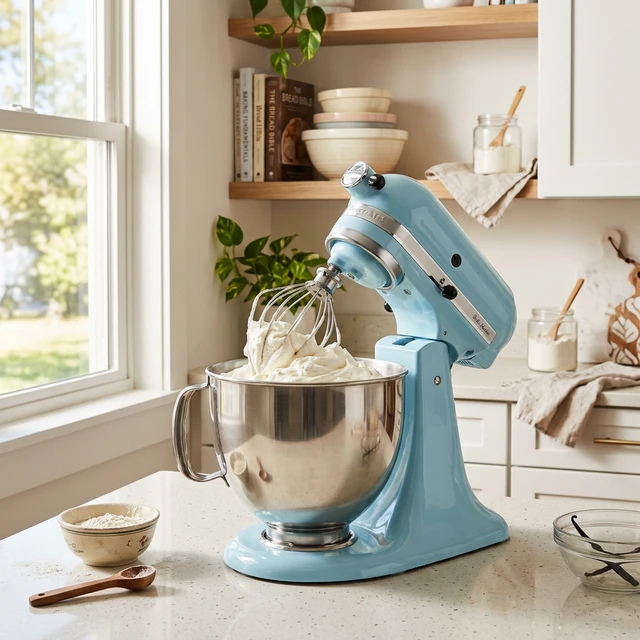
KitchenAid Artisan Series 5-Quart Tilt-Head Stand Mixer
KitchenAid
The undisputed icon of the home kitchen, versatile enough for everything from whipped cream to heavy bread dough.
Price: ~$400 on Amazon
3. Best Value for Bread: Cuisinart Precision Master SM-50 (500W)
At roughly $180, the Cuisinart SM-50 offers more raw motor power than the KitchenAid Artisan at half the price. For bread baking specifically, it’s an outstanding value.
The 500-watt motor handles single batches of any bread dough — white, whole wheat, rye, bagels — without strain. Double batches of standard bread dough work fine. Only the stiffest double-batch recipes (double batch of bagels) push it toward its limits.
The 5.5-quart bowl gives you slightly more room than the Artisan’s 5-quart bowl, which matters when bread dough is climbing the hook and expanding.
What bakers love:
- 500 watts at a $180 price point is remarkable
- Handles stiff doughs better than the KitchenAid Artisan
- 12-speed dial with dedicated fold setting
- Splash guard included
- Die-cast metal body feels solid
The tradeoffs:
- Tilt-head design can bounce during very heavy loads
- Lighter weight (18 lbs) means less stability than heavier mixers
- C-hook design requires periodic scraping
- Limited attachment ecosystem
- Louder than KitchenAid at high speeds
- 3-year warranty is shorter than KitchenAid’s 5-year
Multiple users on r/Baking have called the SM-50 “the best bread mixer under $200” — and that assessment holds up based on the specs. If your budget is under $200 and bread is a primary use, this is the mixer to buy.

Cuisinart Precision Master 5.5-Quart Stand Mixer (SM-50)
Cuisinart
A feature-rich and powerful alternative to the classic KitchenAid at a competitive price point.
Cuisinart Precision Master SM-50
Price: ~$180 on Amazon
4. Most Popular (But Limited for Bread): KitchenAid Artisan (325W)
The Artisan is the world’s most popular stand mixer, and it handles bread dough — with caveats. A single batch of standard white or wheat bread dough kneads perfectly in 8-10 minutes at speed 2. The motor doesn’t strain, the mixer stays in place, and the dough develops good gluten structure.
Where the Artisan struggles is with heavy loads:
- Double batches: The mixer walks across the counter and the motor runs hot
- Very stiff doughs: Bagels and low-hydration whole wheat can overwhelm the 325-watt motor
- Extended kneading: Sessions over 10 minutes with stiff dough push the motor harder than KitchenAid recommends
KitchenAid’s own manual states that the Artisan should not be used at speed 2 for more than 8-10 minutes with bread dough. That’s usually enough, but it’s a real limitation.
That said, millions of home bakers make bread with Artisans every day and are perfectly happy. If you bake bread once or twice a week in single batches, the Artisan works. If bread is your primary focus and you bake large or stiff batches, the Professional 600 or Cuisinart SM-50 are better choices.
KitchenAid Artisan Series 5-Quart Tilt-Head Stand Mixer
KitchenAid
The undisputed icon of the home kitchen, versatile enough for everything from whipped cream to heavy bread dough.
KitchenAid Artisan 5-Qt Stand Mixer
Price: ~$350 on Amazon
5. European Powerhouse: Kenwood Chef XL Titanium (1700W)
The Kenwood is a popular choice in the UK and Europe but harder to find (and less commonly discussed) in the US. Its 1700-watt motor is dramatically overpowered for home use — this is a machine that won’t struggle with anything you throw at it.
The fold-back head design offers better access than a tilt-head, and the 6.7-quart bowl handles large batches easily. Kenwood’s planetary mixing action is thorough, and their spiral dough hook is well-designed.
What bakers love:
- Absurd motor power — nothing phases it
- Large bowl capacity
- Well-built European engineering
- Decent attachment ecosystem (not as large as KitchenAid’s)
- EasyWeigh built-in scale on some models
The tradeoffs:
- ~$600 price tag
- Less common in the US — parts and support can be harder to find
- Bulky footprint
- The motor power is overkill for most home baking
- Fewer US retailers carry it
If you’re in Europe or can source one easily, the Kenwood is a serious bread machine. In the US, the Ankarsrum or KitchenAid Professional 600 are more practical choices.
Price: ~$600 (varies by retailer)
Dough Hook Types and Why They Matter
Not all dough hooks are equal. The type of hook significantly affects kneading quality.
C-Hook (Most Common)
Found on KitchenAid Artisan, Cuisinart SM-50, and most tilt-head mixers. Shaped like a letter C, it pulls and stretches dough in a circular motion. Works well for most doughs but tends to push dough up the hook shaft, requiring periodic scraping.
Spiral Hook
Found on KitchenAid Professional series, Kenwood, and some Bosch models. A true spiral that pulls dough down toward the bowl bottom while stretching it. More efficient kneading — less scraping required, more even gluten development.
Roller and Scraper (Ankarsrum)
Unique to the Ankarsrum. A fixed roller presses dough against the rotating bowl wall while a scraper folds it over. Mimics the stretch-and-fold technique used by artisan bakers. Produces the best crumb structure but can’t do non-bread tasks well.
For bread specifically: Spiral hooks and the Ankarsrum’s roller system are superior to C-hooks. If you’re choosing between two similar mixers, pick the one with a spiral hook.
Hydration and Dough Type Guide
Different breads put different demands on your mixer. Here’s what to expect:
| Bread Type | Hydration | Difficulty | Minimum Recommended |
|---|---|---|---|
| White sandwich bread | 60-65% | Easy | 300W, any mixer |
| Whole wheat bread | 65-70% | Medium | 400W+ recommended |
| Sourdough (standard) | 70-75% | Medium | 400W+ recommended |
| Ciabatta | 80-85% | Easy on motor, messy | Any mixer works |
| Rye bread | 65-70% | Hard (sticky, heavy) | 500W+ recommended |
| Bagels | 50-55% | Very hard (stiff) | 500W+ strongly recommended |
| Brioche | 65% (high fat) | Hard (butter incorporation) | 400W+ recommended |
| Pizza dough | 60-65% | Medium-hard | 400W+ for multiple balls |
Key takeaway: If you regularly bake anything below 60% hydration or above 70% whole grain content, invest in a 500-watt or higher motor. It’s the difference between a mixer that works hard and a mixer that barely notices the load.
Common Bread-Kneading Mistakes
Kneading Too Fast
Speed 2 is the correct setting for bread dough on virtually every stand mixer. Higher speeds heat the dough through friction, which can kill yeast and produce off-flavors. Speed 4 is not “faster kneading” — it’s ruined dough.
Kneading Too Long
Bread dough in a stand mixer needs 8-12 minutes. Over-kneading breaks down gluten strands you just built, producing dense, tough bread. Check with the windowpane test at 8 minutes.
Overloading the Bowl
Filling the bowl past 2/3 capacity restricts dough movement and creates dead zones where flour doesn’t incorporate. Use a larger bowl or split into batches.
Not Scraping Down
Especially with C-hooks, dough climbs the hook and flour sticks to the bowl bottom. Stop twice during kneading to scrape the hook and bowl sides with a flexible spatula.
Starting Too Fast
Add flour gradually at stir speed, then increase to speed 2 once incorporated. Dumping flour and hitting speed 4 creates a flour explosion and uneven mixing.
What the Reddit Bread Communities Say
We tracked discussions on r/Breadit, r/Sourdough, and r/Baking for mixer recommendations specific to bread. The most common advice:
Budget recommendation (under $200): Cuisinart SM-50, almost universally. “Best bang for buck for bread making, full stop.”
Mid-range recommendation ($300-500): KitchenAid Professional 600. “Bowl-lift, more power, same attachment ecosystem. Worth the upgrade over the Artisan if bread is your thing.”
Enthusiast recommendation ($500+): Ankarsrum Original. “Nothing kneads bread like it. It’s not even close. But it’s a one-trick pony for everything else.”
Most controversial: The KitchenAid Artisan. Bread bakers are split — some love it, some say it’s underpowered for serious bread. The consensus is that it works for casual bread baking but falls short for dedicated bread bakers who make stiff or large batches.
Our Recommendation
For most home bakers who make bread weekly: The Cuisinart SM-50 at ~$180. It has the power, it handles stiff doughs, and the price leaves room in your budget for quality flour and a good scale.
For serious bread bakers who also bake other things: The KitchenAid Professional 600 at ~$400. Bowl-lift stability, 575 watts, spiral dough hook, and the full attachment ecosystem.
For dedicated bread enthusiasts who prioritize crumb quality above all else: The Ankarsrum Original at ~$650. Nothing kneads bread better. Accept that it’s mediocre at everything else.
Skip the KitchenAid Artisan if bread is your primary use. It’s the best all-purpose mixer on the market, but dedicated bread bakers will hit its 325-watt ceiling within months. Get the Professional 600 instead.
Related Guides: See our full KitchenAid vs Cuisinart comparison for a detailed head-to-head. For a broader look at all stand mixer options, check out our best stand mixers for home bakers.
Marcus Chen
Editor & Lead Reviewer
Marcus Chen is the editor of KitchenwareAuthority.com. With dozens of articles published and hundreds of hours researching kitchen tools, he focuses on honest recommendations based on real user experiences, community feedback, and manufacturer specifications.
Upgrade Your Kitchen Skills
Get research-backed gear reviews, maintenance tips, and exclusive buying guides delivered to your inbox.
Join 15,000+ home cooks. No spam, ever.