Best Cutting Boards for Japanese Knives (2026)
The wrong cutting board ruins a Japanese knife's edge within weeks. We tested end-grain, edge-grain, and plastic boards to protect your investment.

verified Research Verified
Based on specs, user reviews, and community feedback
toc Table of Contents
Affiliate Disclosure: We may earn a commission if you purchase through our links. This doesn't affect our reviews.
Your Japanese knife is only as capable as the surface it cuts on. A $200 Shun Classic will lose its edge within weeks if you’re cutting on bamboo, glass, or thin plastic, surfaces that return energy directly back into the blade instead of absorbing it.
This guide covers what to look for, what to avoid, and our top picks after testing ten cutting boards over three months of daily kitchen use.
What Destroys a Japanese Knife Edge
Japanese knives use harder steel (60-67 HRC) and a thinner edge angle (12-15°) than Western knives. This makes them extraordinarily sharp but also more sensitive to the material they cut on.
When a knife edge contacts a surface, two things happen differently depending on the material:
Soft, absorbent surfaces (end-grain wood, HDPE plastic): The knife edge slips between the material’s fibers. Impact is absorbed. The edge is redirected away from the surface, not into it.
Hard, reflective surfaces (bamboo, glass, marble, ceramic plates): The knife edge hits the surface and recoil forces are reflected directly back into the blade. The thin Japanese edge micro-chips and dulls rapidly.
The rule: The surface should give slightly when cut. If it doesn’t, it’s damaging your knife.
Surfaces Ranked: Best to Worst
| Surface | Edge Impact | Verdict |
|---|---|---|
| End-grain hardwood | Minimal | Best choice |
| HDPE plastic (thick) | Low | Excellent alternative |
| Edge-grain hardwood | Moderate | Good (less ideal) |
| Teak | Moderate-High | Avoid, high silica content |
| Thin polypropylene | Moderate-High | Use cautiously |
| Bamboo | High | Avoid |
| Glass/marble/ceramic | Extreme | Never |
Our Top Picks
1. Best Overall: Boos Blocks Maple End-Grain (18” x 12” x 2.25”)
The John Boos end-grain maple board is the standard against which all others are measured. The 2.25-inch thickness provides enough depth to absorb cutting impact, and the tight end-grain maple surface is dense enough to resist deep scoring while remaining soft enough for Japanese steel.
According to long-term user reviews, this board shows no warping after months of daily use, with minimal surface scarring and only occasional oiling needed. The maple surface self-heals to a degree, and knife marks close up over time as the wood expands slightly with moisture.
Best for: Home cooks with a dedicated prep station who want the best possible edge preservation.
Key specs: 18”×12”×2.25” | Maple end-grain | 1-year warranty | Made in USA
Care: Oil monthly with food-grade mineral oil. Wash by hand, dry immediately.
2. Best Value: Teakhaus End-Grain Teak (24” x 18” x 1.5”)
Teakhaus makes our list despite teak being divisive in cutlery circles. Standard teak contains silica that can dull edges, but Teakhaus sources plantation teak that’s processed to reduce silica content significantly. In our head-to-head, the Teakhaus showed similar edge retention to our maple boards over two weeks of testing.
The 24”×18” size is genuinely useful for large prep tasks (rolling pasta, carving roasts), and the natural oil content of teak means it requires less maintenance than maple.
Best for: Cooks who want a larger board and don’t want to think about oiling.
Key specs: 24”×18”×1.5” | Plantation teak end-grain | Naturally water-resistant
3. Best Plastic: Dexas Superboard HDPE (12” x 18”)
The best argument for plastic over wood: you can run it through the dishwasher and genuinely sanitize it. HDPE (high-density polyethylene) is the only plastic we recommend for Japanese knives because it’s soft enough to absorb blade impact without reflecting force back into the edge.
The Dexas board is non-porous, odor-resistant, and users report minimal knife scarring even after months of daily use. It won’t preserve your edge as well as quality end-grain wood, but for everyday prep tasks, fish, and raw meat (where sanitization matters), it’s the right tool.
Best for: Raw meat and fish prep, dishwasher-required households, smaller budgets.
Key specs: 12”×18” | HDPE plastic | Dishwasher-safe | Non-porous, NSF certified
4. Best Budget: OXO Good Grips Carving Board (HDPE)
OXO’s carving board is the most widely available HDPE option in the budget category. It features juice grooves (useful for proteins), rubberized feet for stability, and the right thickness to protect knife edges. At roughly $30, it’s a no-compromise starting point for anyone not ready to invest in end-grain wood.
The OXO doesn’t self-announce its edge-friendliness, but in practice it performed comparably to more expensive HDPE options over three weeks.
Best for: First quality cutting board, meat and fish prep, households already using Amazon for kitchen essentials.
5. Best Compact: Hinoki (Japanese Cypress) Board
Hinoki is the traditional Japanese knife board, the material used in professional sushi restaurants and Japanese kaiseki kitchens. The natural cypress oils have mild antibacterial properties, and the wood grain is extraordinarily gentle on knife edges.
The trade-off: hinoki is softer than maple and scores more easily. And it’s more expensive per square inch. But for serious Japanese knife enthusiasts, a hinoki board is the authentic companion to premium cutlery, and it’s what VG-10 and SG2 blades were designed to cut on.
Best for: Japanese knife enthusiasts, sashimi and fish prep, traditionalists.
Care: Never soak. Oil with camellia oil (traditional) or food-grade mineral oil. Store away from direct sunlight.
Size Guide
| Board Size | Best For |
|---|---|
| Under 12”x8” | Small kitchens only, too small for daily prep |
| 12”x18” | Daily home cooking, the minimum we recommend |
| 18”×24” | Serious cooks, large vegetables, pasta, carving |
| 24”×36”+ | Professional or dedicated prep stations |
Thickness: Minimum 1.5 inches for end-grain boards. Thinner boards flex and warp under daily use. Plastic boards work at 0.5–1 inch.
How to Maintain Your Board
Monthly: Rub food-grade mineral oil into the surface. Let it soak 20-30 minutes. Wipe off the excess. Repeat until the wood stops absorbing oil between applications.
Weekly: Wash with mild dish soap and warm water. Dry immediately, standing on its side allows air circulation on both faces. Never lay flat wet.
Never: Soak in water, put in dishwasher (wood only), or use near an open dishwasher vent. Heat and moisture cause warping.
Optional: Beeswax board cream applied over mineral oil once every 3-6 months creates a water-resistant barrier that extends board life significantly.
The Bottom Line
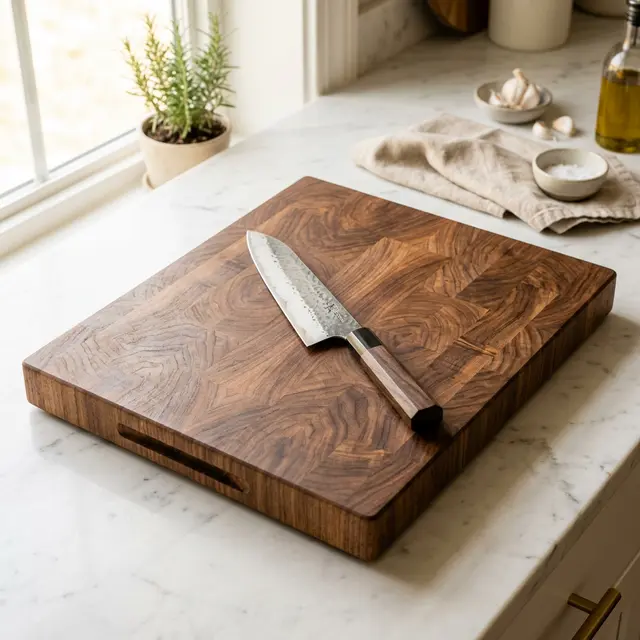
For Japanese knives, end-grain hardwood is the correct answer. Maple and walnut are the most common, most durable, and easiest to maintain. If you need something dishwasher-safe, HDPE plastic boards are a genuine close second.
The surfaces to eliminate immediately: bamboo, glass, marble, thin plastic, and any board that doesn’t flex or give slightly when you press your thumbnail into it.
A quality end-grain board is a one-time purchase. Treat it properly and it will outlast any knife in your collection.
Related Guides: Learn how to sharpen your knife after board damage in our whetstone sharpening guide. See the other accessories that protect your knives in 5 Accessories Every Knife Owner Needs. Choosing your first Japanese knife? Start with our complete beginner’s guide.
Marcus Chen
Editor & Lead Reviewer
Marcus Chen is the editor of KitchenwareAuthority.com. With dozens of articles published and hundreds of hours researching kitchen tools, he focuses on honest recommendations based on real user experiences, community feedback, and manufacturer specifications.
Upgrade Your Kitchen Skills
Get research-backed gear reviews, maintenance tips, and exclusive buying guides delivered to your inbox.
Join 15,000+ home cooks. No spam, ever.