Best Cutting Board Material: Wood vs Plastic vs Bamboo
Best cutting board material guide. Compare wood, plastic, bamboo, and rubber boards for knife care, hygiene, durability, maintenance, and value.

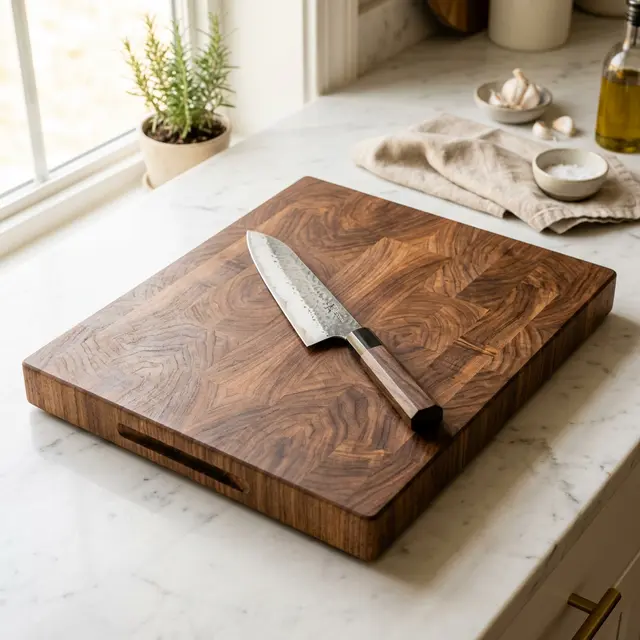
Table of Contents
Affiliate Disclosure: We may earn a commission if you purchase through our links. This doesn't affect our reviews.
Listing check: Amazon titles and photos change. Confirm the steel, length, and model named on this page match the listing before you buy — this is a research note from Nora Whitfield, not a copy of the Amazon product copy.
Best Cutting Board Material: Quick Answer
For most home cooks, the best cutting board material is hardwood, especially maple or walnut. Wood is gentler on knives than plastic or bamboo, lasts much longer than plastic, and feels better for daily prep. The best setup is not one board, though. It is a large wood board for vegetables, fruit, bread, herbs, and cooked foods, plus a dishwasher-safe plastic board for raw meat and poultry.
That hierarchy is what emerges when you line up owner-review consensus for the leading boards in each material, manufacturer specifications, and published food-safety guidance. Wirecutter's long-running cutting board guide lands in the same place: a wood board for most prep, cheap plastic reserved for raw proteins.
| Need | Best cutting board material | Why |
|---|---|---|
| Best overall | Maple or walnut wood | Best balance of knife care, durability, hygiene, and feel |
| Best for raw meat | Plastic / HDPE | Dishwasher-safe and cheap to replace when scarred |
| Best for Japanese knives | End-grain wood or soft rubber | Gentlest on thin, hard edges |
| Best low-maintenance board | Plastic | No oiling, no special care, low replacement cost |
| Best eco-marketing pick | Bamboo | Renewable and affordable, but harder on knives |
| Best material to avoid | Glass, stone, ceramic | Extremely damaging to knife edges |
If you already own premium knives, our must-have chef knives guide covers the blades that deserve a better board. If you are building a whole prep setup, pair this page with our best kitchen knives under $200 and how to sharpen kitchen knives at home — a better board is what keeps that fresh edge alive.
Why Cutting Board Material Matters
Your cutting board is the most-used surface in your kitchen. You put a knife to it dozens of times per meal, it contacts almost every ingredient you prepare, and it takes more physical abuse than any other kitchen tool. The material you choose affects how quickly your knives dull, how effectively you can sanitize the surface, how long the board lasts, and how much you enjoy cooking.
A sharpened edge is microscopically thin where steel meets board. On every stroke, that edge either sinks into a slightly yielding surface or is forced against something unyielding. Glass, stone, ceramic, and very hard bamboo push back hard enough to roll or chip the edge. The wrong material can undo the value of a good knife in a single heavy session — which is why a better board is not just a nicer surface. It is part of knife maintenance, stretching the interval between sessions on a beginner whetstone or whatever sharpening method you use.
Wood Cutting Boards
Why Wood Is Usually Best
Professional cooks overwhelmingly choose wood for primary prep because wood is kind to knife edges. When a blade strikes a wood board, the fibers yield slightly instead of pushing back like a hard countertop. That makes chopping feel smoother and helps preserve the edge.
Wood also ages better than plastic from a hygiene standpoint. The USDA's food safety guidance on cutting boards summarizes decades of food-microbiology research: bacteria on sound hardwood tend to become unrecoverable as the wood dries, while deeply knife-scarred plastic traps soil and bacteria in grooves that routine washing cannot reach. The USDA's practical takeaways are simple — use one board for raw protein and another for produce and bread, and retire any board once it is badly scarred.
End-Grain vs Edge-Grain
Not all wood boards are built the same way, and the construction affects both feel and price:
- Edge-grain: Boards built from long strips with the grain running along the cutting surface. This is the standard, affordable construction. It is durable, stable, and easier to move.
- End-grain: The wood fibers point up toward the knife, so the edge slips between fibers instead of across them. It is the gentlest wood surface, and scars tend to close visually over time. Expect more weight, more oiling, and a meaningfully higher price.
- Face-grain: The wide face of a single board, chosen for looks. It shows scars most readily and is better suited to serving than heavy daily prep.
The Best Wood Species for Boards
- Hard maple: The standard choice. It is durable, tight-grained, widely available, and gentle enough for daily knife work.
- Walnut: Slightly softer than maple with a darker look and excellent board feel. It is usually more expensive.
- Cherry: Softer than maple and walnut, with a warm color and very knife-friendly feel.
- Teak: Water-resistant and attractive, but often harder on edges because of its natural silica content.
Best Wood Pick: John Boos Maple Board
John Boos maple boards are common in serious home kitchens because they deliver the right combination of size, weight, durability, and price. Maple edge-grain is not as luxurious as a thick end-grain board, but it is practical, easier to move, and still much better for knives than plastic or bamboo.
John Boos Maple Cutting Board
Pros: Excellent knife feel, durable, repairable, long lifespan, strong primary-prep surface.
Cons: Requires oiling, cannot go in the dishwasher, heavier than plastic.
Plastic Cutting Boards
When Plastic Makes Sense
Plastic cutting boards have genuine advantages. They are light, inexpensive, dishwasher-safe, and easy to dedicate to raw meat or fish. If you cook poultry often, a plastic board that can go straight into the dishwasher is genuinely useful, because dishwasher heat does the sanitizing for you.
The weakness is lifespan. Plastic scarred by knife work stays scarred. Those grooves collect moisture and food residue, and per the USDA guidance above, a plastic board with deep cuts becomes difficult to sanitize reliably — at that point it should be replaced, not scrubbed harder.
Plastic is also harder on knives than wood. It is nowhere near as bad as glass or stone, but it does not have the forgiving give of maple, walnut, cherry, or soft rubber.
Best Plastic Pick: OXO Good Grips Utility Board
The OXO Good Grips board is a practical raw-protein board. It has non-slip edges, a useful size, and a price low enough that replacement does not hurt when the surface becomes scarred. If raw-meat prep is the main job you are hiring it for, our dedicated best cutting board for raw meat page goes deeper on that decision.
OXO Good Grips Utility Cutting Board
Pros: Dishwasher-safe, inexpensive, non-slip edges, good for raw meat, easy to replace.
Cons: Scars permanently, dulls knives faster than wood, shorter lifespan.
Bamboo Cutting Boards
Bamboo is popular because it is affordable and renewable. It grows quickly, looks attractive, and resists obvious knife scarring. The problem is performance. Bamboo is technically a grass, not a hardwood, and it is harder than many woods used for cutting boards. It also contains silica, which makes it more abrasive on knife edges.
That does not make bamboo useless. It is fine for serving, bread, fruit, cheese, and casual prep with inexpensive knives. But if you own good chef knives, especially Japanese knives, it is not the best material for your main board.
Best Bamboo Pick: Totally Bamboo Kauai
If you specifically want bamboo, Totally Bamboo's Kauai board is a reasonable budget option. Use it as a secondary board, not as the main surface for premium knives.
Totally Bamboo Kauai Cutting Board
Pros: Affordable, lightweight, renewable, attractive enough for serving.
Cons: Harder on knives than wood, cannot go in the dishwasher, can split if neglected.
What About Rubber and Composite Boards?
Soft synthetic rubber boards, including the boards used in many Japanese kitchens, are excellent for knife edges. They are especially good for hard, thin Japanese knives because the surface has more give than plastic. The downsides are price, weight, staining, and availability. If you own blades from any of the best Japanese knife brands, a soft rubber or end-grain wood board is the pairing that protects your investment.
Composite boards such as paper-composite surfaces are more convenient than wood and often dishwasher-safe, but they can be harder on knives than maple or walnut. They are useful for cooks who want a thin board that stores easily and needs less care, but they are not the first choice for edge preservation.
For most homes, rubber is the premium specialty choice, wood is the best everyday choice, and plastic is the best raw-meat utility choice.
Material Comparison
| Feature | Wood | Plastic | Bamboo | Soft rubber |
|---|---|---|---|---|
| Knife-friendliness | Excellent | Fair | Fair to poor | Excellent |
| Hygiene over time | Excellent if dried properly | Good when new, worse when scarred | Good if maintained | Good |
| Dishwasher-safe | No | Yes | No | Usually no |
| Typical lifespan | 5-20 years | 1-2 years | 3-5 years | 5+ years |
| Maintenance | Oil monthly | Replace when scarred | Oil monthly | Wash and dry carefully |
| Best use | Daily prep | Raw meat | Serving and casual prep | Premium knife work |
| Main drawback | Needs care | Short lifespan | Hard on knives | Expensive |
Lifespan figures are typical ranges reported by owners and manufacturers, not measured test results — a well-maintained maple board routinely outlives several generations of plastic boards, and a neglected one can crack in a dry apartment within a year.
How to Care for Each Material
- Wood: Hand wash with hot soapy water, rinse, towel dry, and stand upright to finish drying. Never soak it, never put it in the dishwasher. Once a month or whenever the wood looks pale and dry, rub in food-grade mineral oil (or a mineral oil and beeswax board cream) and wipe off the excess.
- Plastic: Dishwasher-safe in most cases. Inspect the surface periodically and replace the board once grooves are deep enough to hold soil.
- Bamboo: Treat like wood — hand wash, dry promptly, and oil occasionally, because the grass fibers split when allowed to dry out completely.
- Soft rubber: Scrub both sides, rinse, and air dry. Check the manufacturer's guidance before dishwashing, since heat tolerance varies.
Recommended Two-Board Setup
The best answer for most kitchens is not choosing one material for everything. Use two boards:
- Large maple or walnut board for daily prep. Use it for vegetables, herbs, fruit, bread, cooked meat, and general knife work.
- Plastic board for raw meat and poultry. Use it when dishwasher sanitizing matters more than knife feel.
This mirrors the cross-contamination advice in the USDA guidance linked above: separate boards for raw protein and everything else, and replace any board — wood, plastic, or bamboo — that has become too scarred to clean with confidence. The setup gives you the best of both worlds: a knife-friendly daily surface and a low-maintenance sanitation board for higher-risk foods.
Matching the Board to Your Knives
- Soft Western steel knives (typical German-style chef knives) sharpen to slightly more robust edges and tolerate any wood or plastic board without complaint.
- Hard Japanese steel knives have thinner, harder edges that chip on unyielding surfaces. Give them end-grain wood or soft rubber, and keep them away from bamboo, glass, and stone.
- Budget knife sets are cheap to re-sharpen, so bamboo's extra edge wear matters less. Our best knife set under $100 picks are a fine pairing for a bamboo or basic plastic board.
For everything you need to know about restoring whatever edge your board has worn down, see our complete kitchen knife sharpening guide.
Final Verdict
The best cutting board material for most cooks is wood. Maple is the safest default, walnut is the premium-feel upgrade, and end-grain wood or soft rubber is best for expensive Japanese knives. Plastic still belongs in the kitchen as a raw-meat board. Bamboo is acceptable for light use, but it is not the best primary prep board if knife care matters.
For a simple buy-once setup, start with a John Boos maple board and add an OXO plastic board for raw proteins.
John Boos Maple Cutting Board
FAQ
What is the best cutting board material?
Wood is the best cutting board material for most prep work. Maple and walnut are the strongest defaults because they are durable, knife-friendly, repairable, and long-lasting.
What is the best cutting boards material for Japanese knives?
The best cutting boards material for Japanese knives is end-grain maple, walnut, cherry, or soft rubber. Avoid glass, stone, ceramic, and most bamboo boards.
Are wood cutting boards sanitary?
Yes, if cleaned and dried properly. Food-safety research summarized by the USDA has repeatedly found that bacteria in sound hardwood become unrecoverable as the board dries. Wash with warm soapy water, rinse, towel dry, and stand the board upright. Do not soak it or put it in the dishwasher.
Should I use plastic for raw chicken?
Yes, a dedicated plastic board is practical for raw chicken because it can go in the dishwasher. Replace it once deep grooves develop — that is the point where the USDA considers a scarred board hard to sanitize.
Do bamboo cutting boards dull knives?
Yes. Bamboo is harder and more abrasive than maple or walnut, so it dulls knives faster. It is fine for casual use but not ideal for premium knife edges.
How often should I oil a wood cutting board?
Oil a wood board roughly once a month, or whenever the surface looks pale, dry, or chalky. Use food-grade mineral oil, apply it generously, let it soak in briefly, then wipe off the excess before the next use.
Nora Whitfield
Writer, Kitchenware Authority
Nora Whitfield writes Kitchenware Authority's reviews and buying guides. Every knife, pan, and appliance is vetted against maker specifications, materials and safety documentation, and the long-run experience verified home cooks report — not first-hand lab tests.
Upgrade Your Kitchen Skills
Get research-based gear reviews, maintenance tips, and buying guides from the Kitchenware Authority desk.
No spam. Research notes from Nora Whitfield, not invented reader counts.